

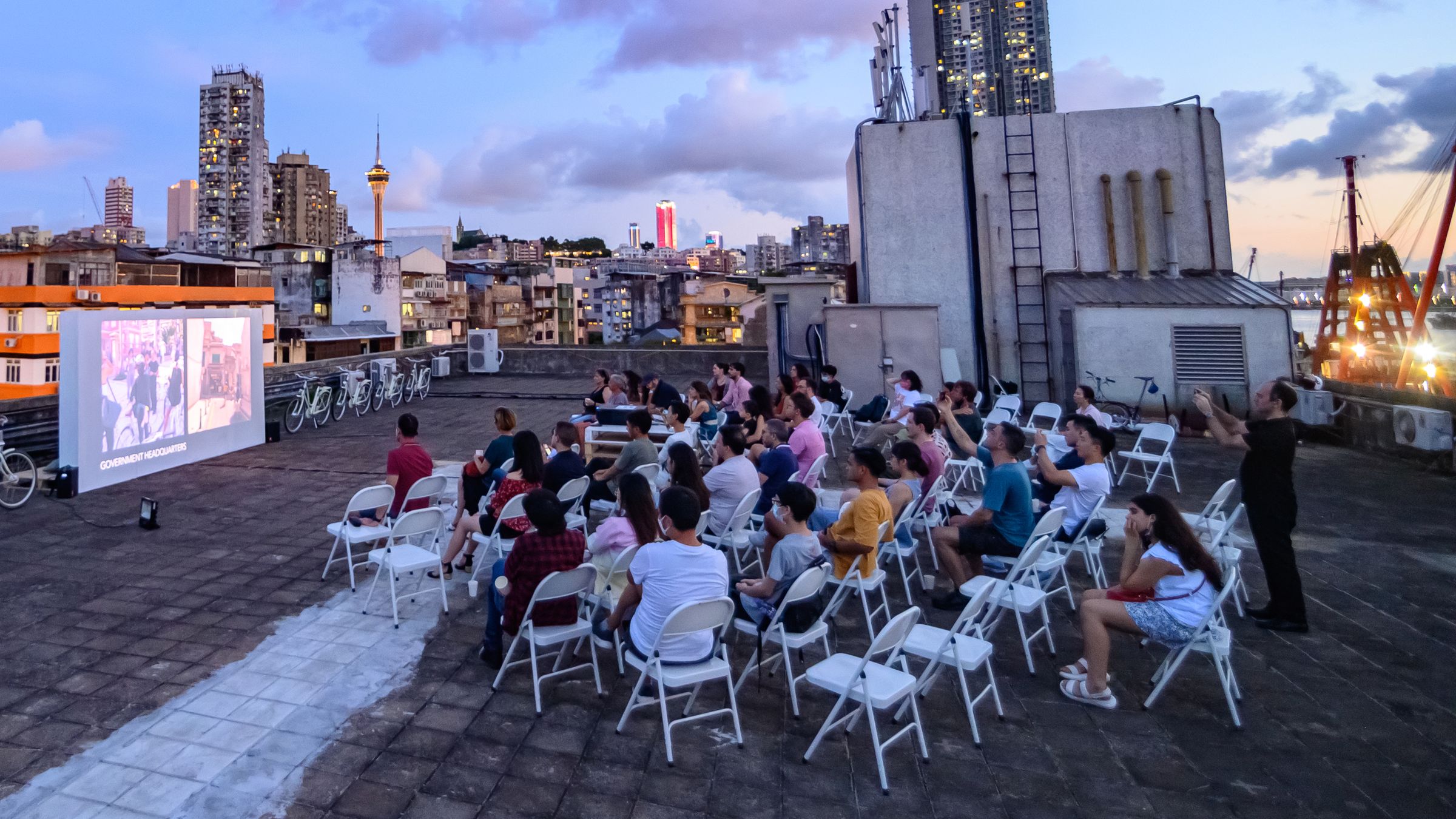
Architecture under the night sky.
In the spirit of this year’s Open House Macau theme, Dialogues, OHM Archi Film explores the many conversations that architecture generates beyond the built object itself. Through a selection of films from and about Macau, the programme is organised around three thematic dialogues: Architecture & Art, Architecture & Communities, and Architecture & Practice.
Architecture & Art – Between Space and Expression presents a short film exploring the work of Portuguese urban artist Vhils in Macau, alongside four short films selected in partnership with the ROLLOUT Dance Film Festival. Together, these works investigate the relationship between the body, movement, and the built environment, revealing architecture as a space for artistic expression and interpretation.
Architecture & Communities – Between Place and People presents a film about one of Macau’s most iconic neighbourhoods, exploring how social relationships, memories, and everyday life are shaped by the spaces people inhabit.
Architecture & Practice – Between Vision and Construction presents two architects whose work has contributed to shaping Macau’s urban landscape. Through two distinct practices and approaches to design, the films reflect on architecture as a process of negotiation between ideas, context, and the city itself.
From artistic interventions and cinematic explorations of space to stories rooted in neighbourhoods and everyday life, and reflections on the architects who have helped shape Macau, the screenings reveal architecture as a cultural practice that connects people, places, memories, and ideas.
Together, these films invite audiences to consider architecture not as a static discipline, but as an ongoing dialogue between space and expression, place and people, and vision and construction.
This film tries to tackle the pace at which the world is moving today. It has sped up dramatically from 20 years back. And while that has brought us infinite positive things and progress, it also created new questions and paradigms. Is the world still a big place? We take 3 hours to drive 300 km, but we can send a photograph to the other side of the world in one second. We’re constantly texting, talking, posting about everything and anything, but are we really communicating most of the time? And maybe more importantly – is anybody really listening?
The short film won the Jury Award and the Online Audience Choice Award of the Rolling48Challenge in 2025. It was made within 48 hours in response to the topic “moving through” announced by ROLLOUT Dance Film Festival.
It explores how an individual’s living space changes from a third-person perspective. Observed from the outside, a private environment is transformed into a “representation” of space that can be seen and reflected upon, revealing the subtle and complex relationship between people and space – and how space holds and shapes states of being.
Countless entrances are elusive starting points, every coincidence is an instantaneous explosion, and the footprints vary or disappear in different dimensions. Who am I? Where am I? It is finding the path that has been forgotten and the path that has already been destined.
The Fortress of São Tiago da Barra was constructed in 1629. It was one of the most important fortresses in Macao for its strategic value and location, as it guarded the water entrance towards the Inner Harbour. As time goes by, the fortress has been restored and renovated for different roles, such as being a military site, cultural relics, and a hotel. Today, one needs to pass through a time-tunnel like passage to enter Pousada de São Tiago, making it a small planet of its own, one which retains its own sense of history.
A short documentary that offers an intimate portrait of Iao Hon, one of Macau’s most densely populated neighbourhoods. Through the stories of its residents, the film reflects on childhood memories, family bonds, everyday life, and perseverance, revealing the human experiences that have shaped this community over the past decades.
Learning from Macau is a visual essay about five works by the architect Manuel Vicente in Macau: Fai Chi Kei (1981), TDM (1964–88), the Areia Preta Fire Station (1991–98), the Historical Archive (1983–85), and the Helen Liang Orphanage (1964–65). More than a reading of architecture, José Maçãs de Carvalho’s films offer a reflection on Macau and on the place of space within contemporary society.
This documentary traces the remarkable story behind three emblematic buildings designed by architect José Maneiras, revealing how each structure embodies the aspirations and tensions of a rapidly transforming Macau. In a territory marked by density, cultural layering, and constrained topography, Maneiras responded with clarity, elegance, and a profound sense of civic responsibility. His architecture, firmly rooted in the principles of Modernism, demonstrates how thoughtful design can elevate everyday life.