
Shipbuilder's Guildhall
工羡行會館
- Architect
- —
- Year
- Early 20th century
- Style
- Vernacular Chinese · Art Deco
- Area
- North
The Shipbuilder's Guildhall is an early Chinese guild that records Macau’s shipbuilding heritage and grassroots education.
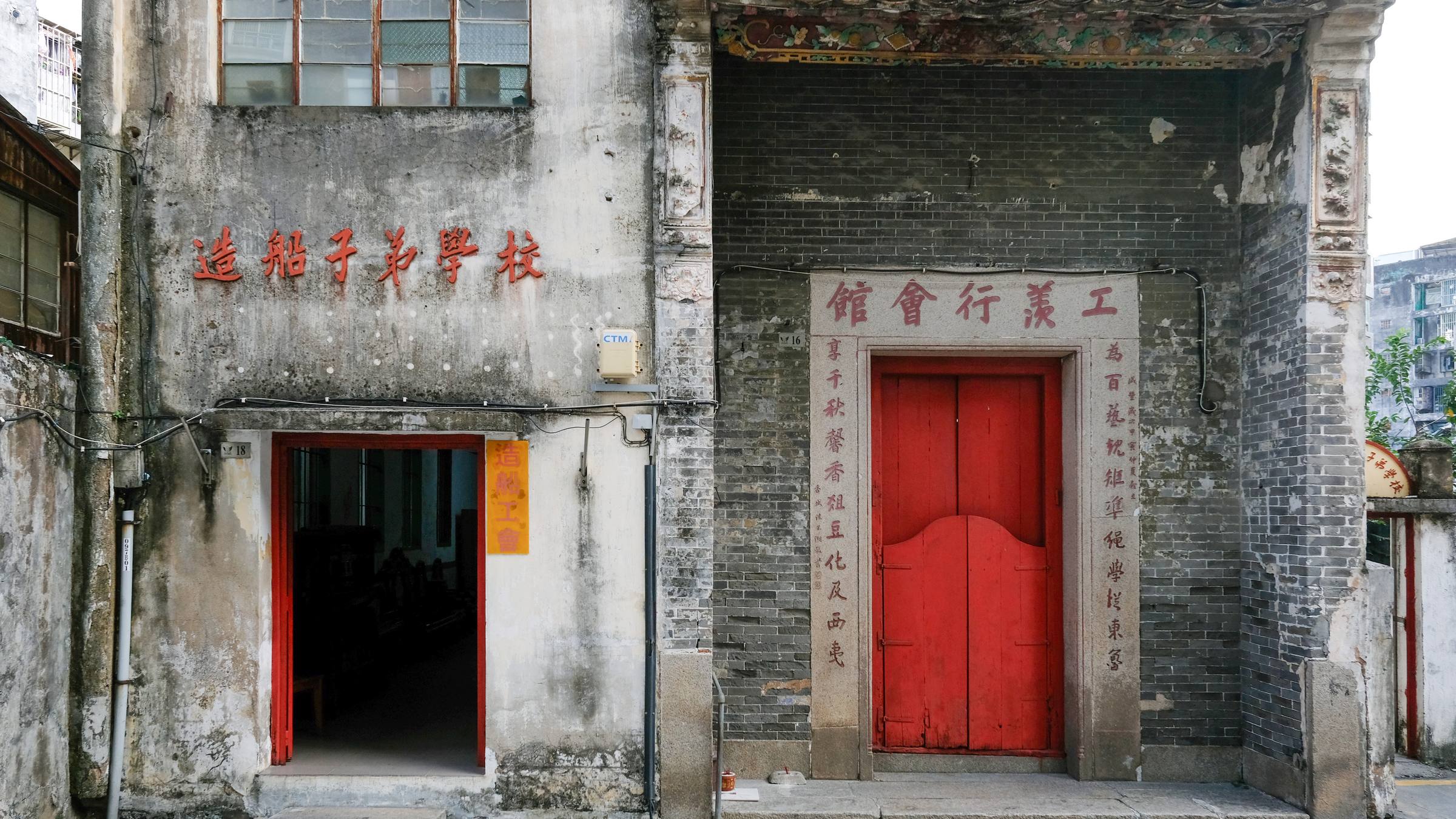
Located at Rua de Pedra, San Kio, the Shipbuilder's Guildhall was founded in 1854 and ranks among Macau’s earliest Chinese trade guilds. From the late Ming to mid‑Qing period, shipyards thrived around San Kio and Patane, drawing a large community of shipwrights. The guild served as a meeting place for the trade and honours Lu Ban, patron god of carpentry, also known as the Temple of Master Lu Ban.
The main hall is a traditional Chinese single‑storey building with grey‑brick walls and a gable roof. Its stone lintel bears the name “Shipbuilder’s Guildhall”, paired with a red gate and couplets in classic Lingnan temple‑guild form. Adjoining it stands a mid‑20th‑century modernist building defined by clean geometric volumes and large windows. Side by side, the two structures create a striking contrast, layering traditional Chinese heritage and modern architecture within one street plot.
In 1954, the guild founded the Shipbuilders’ Children School within the premises, enrolling workers’ children and local neighbourhood pupils. Starting with lower primary classes, it expanded to primary six before closing in 1975. A red star emblem on the building’s structure identifies it as one of many "patriotic" charity schools that emerged in Macau during the 1950s—an initiative designed to address the immense demand for education brought about by a massive influx of immigrants from the Chinese mainland. As one of many community‑run charitable schools of that era, it addressed pressing educational needs amid population growth. The site thus stands as a rare physical witness tying Macau’s Chinese community, shipbuilding industry and grassroots education together.
Nearby Sites
Open at the same time, a short walk away.