
Pátio da Claridade
光復圍
- Architect
- —
- Year
- 1869-1912
- Style
- Vernacular Chinese
- Area
- South
Pátio da Claridade is Macau’s largest surviving patio complex, combining traditional courtyard layouts with commercial arcades and historic reinforced concrete architecture.
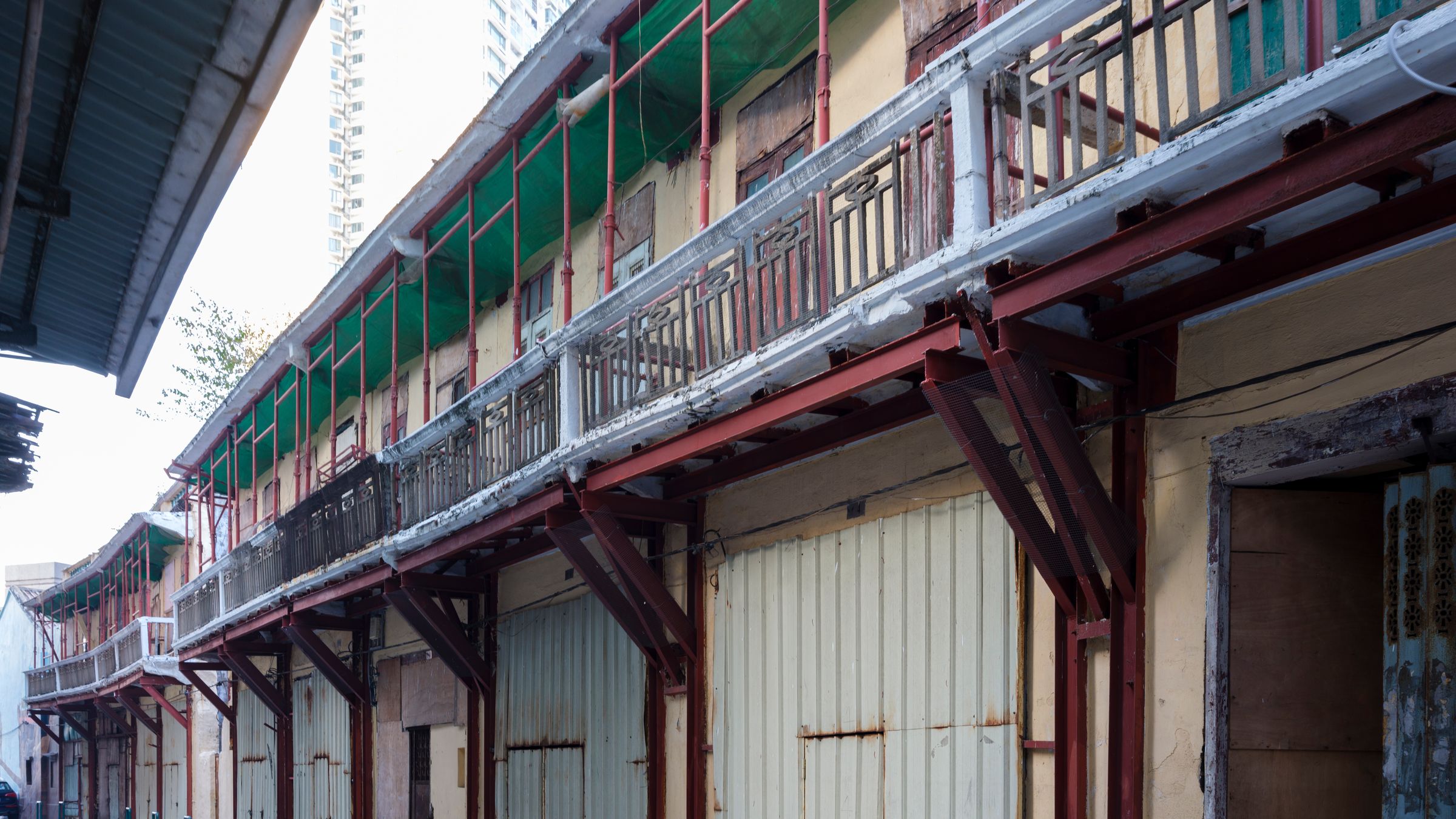
Pátio da Claridade is Macau’s largest surviving patio complex. Around 96 metres long with 48 residential units, its scale resembles a small urban block, distinct from smaller, compact traditional patios. Linked by a T-shaped lane, it sits within the bustling Inner Harbour commercial zone with a mixed residential and commercial character. The complex took shape during urban renewal in the late Qing and early Republican period. Nos.10–12 already existed in 1869, while the full layout was completed in 1910s to 1930s, built as speculative housing for Macau’s growing Chinese population.
It represents a rare hybrid building typology in Macau: it retains the inward-focused communal spatial quality of patios while adopting the arcade commercial model popular along the Inner Harbour in the 19th century. Ground-floor shops open onto the covered arcade walkway. The complex holds four key architectural values. It contains Macau’s longest surviving continuous brick-arch arcade, a vital reference for local arcade studies. Arcade and balcony elements show early use of reinforced concrete, marking a transition to modern construction materials. Nos.10–12 are 19th-century buildings later incorporated into the patio, revealing layered development. The 48 identical modular units share a speculative row-house typology found across the Pearl River Delta.
Constructed with grey-brick load-bearing walls and granite plinths and door frames for damp resistance, the building uses double-leaf lime-mortar walls, timber joists and Lingnan-style double-pitched grey tile roofs. The arcade features hollow brick piers and semicircular brick arches with embedded wrought-iron tie rods to counter thrust, demonstrating skilled masonry techniques of early 20th-century Macau. Most units are vacant today with only sporadic maintenance, yet the historic fabric remains largely intact.
Nearby Sites
Open at the same time, a short walk away.